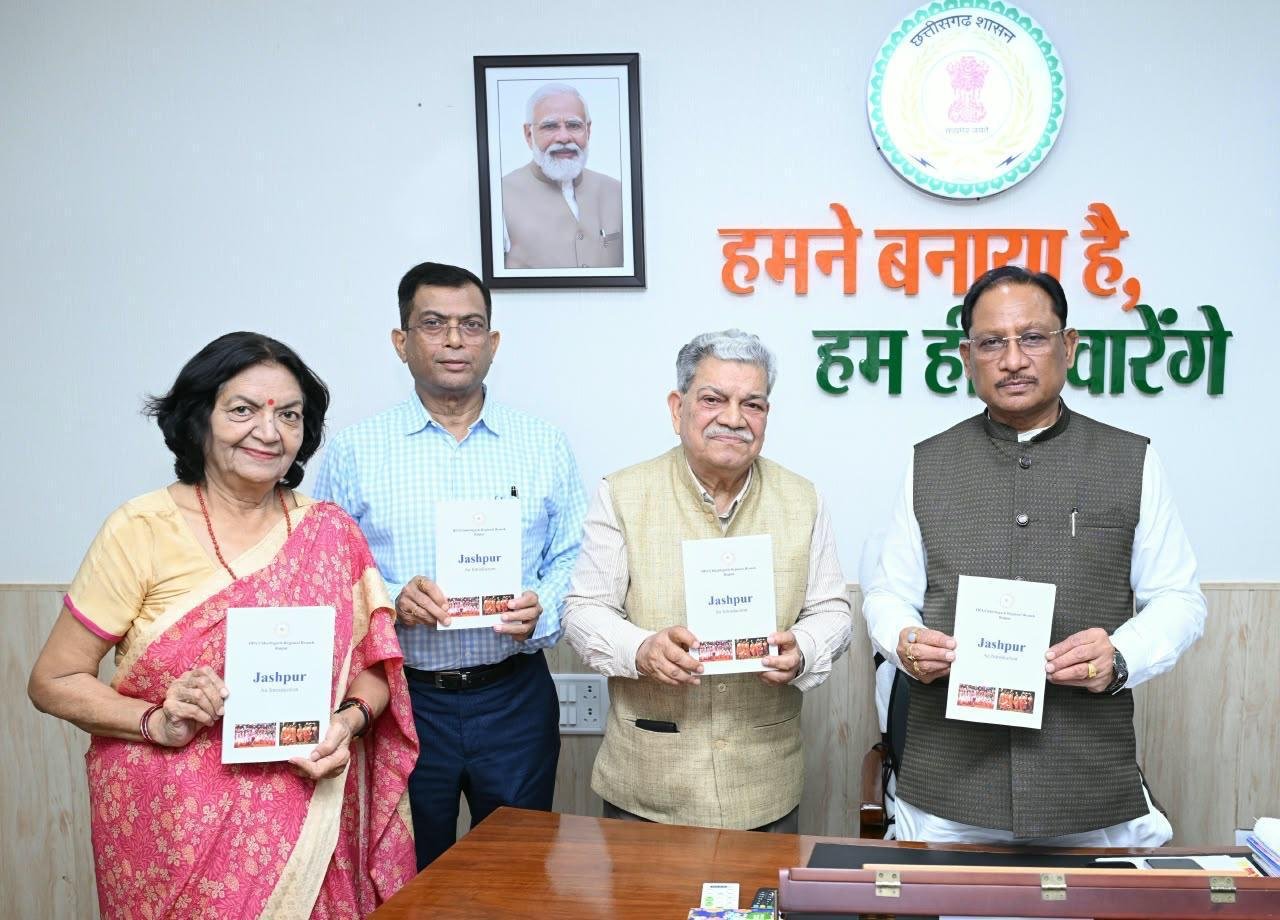
*Publication documents Jashpur’s administrative evolution since Independence, tribal heritage, natural wealth and future growth potential*
*IIPA Chhattisgarh Regional Branch undertakes detailed study of governance, development, culture and socio-economic transformation*
*CM says book will serve as useful reference for administrators, policymakers, researchers and students*
*Study identifies key areas for better governance and sustainable development of tribal-dominated district*
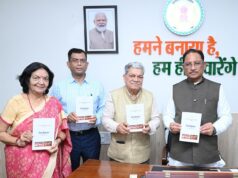
Raipur, Aug 24, 2026/ Chief Minister Shri Vishnu Deo Sai released ‘Jashpur: An Introduction’, a comprehensive publication brought out by the Chhattisgarh Regional Branch of the Indian Institute of Public Administration (IIPA), Raipur, documenting the district’s administrative evolution, governance practices, socio-economic transformation, tribal culture, natural resources and development potential.
The publication traces the changes in Jashpur’s administrative system since Independence and examines the present institutional framework and functioning of the district administration. It also seeks to identify areas that could shape future governance and development strategies for the district.
IIPA Chhattisgarh Regional Branch chairman and retired IAS officer Shri Suyogya Kumar Mishra, Vice-chairperson and retired IAS officer Dr Indira Mishra, and Vice-chairman and retired IAS officer Shri Ajay Singh were present on the occasion.
Congratulating the IIPA regional branch on the publication, CM Shri Vishnu Deo Sai said Jashpur occupies a distinctive place in Chhattisgarh because of its rich natural landscape, cultural diversity and immense development potential.
“Jashpur is blessed with picturesque hills, valleys, rivers, waterfalls and dense forests. Its vibrant tribal communities, traditions and way of life give the district a unique identity. Bringing together these features, along with its administrative experiences and development journey, in the form of a comprehensive publication is a commendable initiative,” the Chief Minister said.
CM Sai said understanding the development trajectory of a region requires a holistic assessment of its history, society, culture, natural resources and administrative institutions.
He said ‘Jashpur: An Introduction’ is significant because it not only presents a picture of the district today but also provides an opportunity to understand how its administrative structure, governance mechanisms and development priorities has evolved over the years.
Chief Minister said that Jashpur’s cultural and ecological profile was markedly different from the plains and industrial belts of Chhattisgarh. As part of the extended Chhotanagpur plateau, the district has its own geographical features, climatic conditions, forest resources and livelihood patterns.
Tribal communities living in the region for generations have preserved their traditions and a way of life deeply connected with nature, he said, adding that this diversity makes Jashpur significant both as an area of academic study and as a region with considerable development potential.
CM Sai said Jashpur had made steady progress in infrastructure, rural development, education, healthcare, livelihood promotion and administrative reforms. He stressed that future development strategies should be framed keeping local requirements, geographical conditions and the district’s social and cultural character at the centre.
“Studies of this nature provide the administration with a deeper understanding of ground realities and can serve as an important basis for identifying future development priorities,” CM said.
Chief Minister said the ultimate objective of governance was to bring about a positive change in the lives of people, particularly those living in remote and tribal areas.
He said expanding access to education, healthcare, roads, communication, employment and livelihood opportunities must go hand in hand with the conservation of local culture and natural resources.
Jashpur, he said, offered significant opportunities to build a development model that balances economic progress with environmental conservation. Agriculture, forest produce, tourism, local products, and women and youth entrepreneurship could emerge as major drivers of the district’s economy.
Highlighting Jashpur’s tourism potential, Sai said the district was among Chhattisgarh’s richest regions in terms of natural attractions.
Its hills, forests, rivers, waterfalls and scenic valleys have the potential to attract visitors from across the country, while its tribal life, folk traditions, traditional arts and local cuisine add to its appeal as a distinctive tourism destination.
Systematic documentation of these strengths, the Chief Minister said, could help Jashpur gain greater visibility at the national and international levels and open new avenues for tourism-linked livelihoods.
CM Shri Vishnu Deo Sai also lauded IIPA’s contribution to the study and improvement of public administration in the country. Through research, training, publications and policy discourse, the institute had played an important role in making administrative systems more effective and citizen-oriented, he said.
He said the initiative to study governance and development at the district level was particularly relevant because India’s development story could not be fully understood without examining the experiences of districts and local administrative institutions.
“District administration is the most crucial link between government and citizens. From implementation of schemes and delivery of public services to addressing local issues, the district-level administrative machinery plays a central role. Documenting successful practices, administrative innovations and challenges can provide valuable lessons for other regions as well,” Sai said.
The chief minister expressed confidence that ‘Jashpur: An Introduction’ would emerge as an important reference for administrators, policymakers, researchers, students and others interested in understanding the district’s social, economic and cultural landscape.
He said the publication would not only take Jashpur’s distinctive identity to a wider audience but also encourage further research and development-oriented studies on the district.
*Part of IIPA’s nationwide initiative*
The study of Jashpur was undertaken as part of a nationwide initiative of the Indian Institute of Public Administration, New Delhi, under which its regional branches were assigned projects to carry out comprehensive studies of at least one district in their respective states.
The initiative aims to examine changes in district administration, governance systems and institutional functioning since Independence, while documenting the development journey of the selected districts.
Apart from assessing existing administrative institutions and processes, the studies are also intended to identify possible directions for strengthening governance and development in the years ahead.
Under the initiative, the IIPA Chhattisgarh Regional Branch selected Jashpur from among the state’s 33 districts.
The district was chosen because of its distinctive geographical, social and cultural characteristics. Located in the northeastern part of Chhattisgarh, Jashpur is a predominantly tribal district whose ecological and cultural profile differs considerably from the state’s agricultural plains and industrial regions.
Its location in the extended Chotanagpur plateau gives it a distinctive landscape characterised by elevated terrain, extensive forests, forest-based livelihoods and a rich tribal heritage.
The publication describes itself not as a conventional district gazetteer but as a concise and comprehensive document bringing together multiple dimensions of Jashpur.
Before becoming a separate district in 1998, Jashpur was a tehsil of Raigarh district. In the absence of a separate district gazetteer for Jashpur, the study drew upon the Raigarh District Gazetteer, Census 2011 data, publications of the Union and state governments, departmental reports and other published material relating to the district.
Another feature of the study is its collaborative nature. Instead of being authored on the basis of the work of a single individual, the publication draws upon information and inputs provided by various departments of the Jashpur district administration.
Data and information obtained from government offices across the district were compiled to present a broader picture of Jashpur’s administrative, social, economic, cultural and developmental profile.
The publication brings together Jashpur’s administrative and development journey with its natural and cultural characteristics, while also identifying areas that merit deeper study in the future.
The IIPA Chhattisgarh Regional Branch has expressed the hope that the publication will serve as an initial comprehensive resource and provide a foundation for more detailed research on Jashpur’s history, administration, society, economy, culture and development potential.
Chief Minister Shri Sai congratulated all those associated with the publication and said the study would help readers understand Jashpur’s past and present while also contributing to a clearer roadmap for its future development. He said the publication would serve as an important bridge between Jashpur’s rich legacy and its emerging opportunities, while helping showcase the district’s unique identity and development potential to a wider audience.